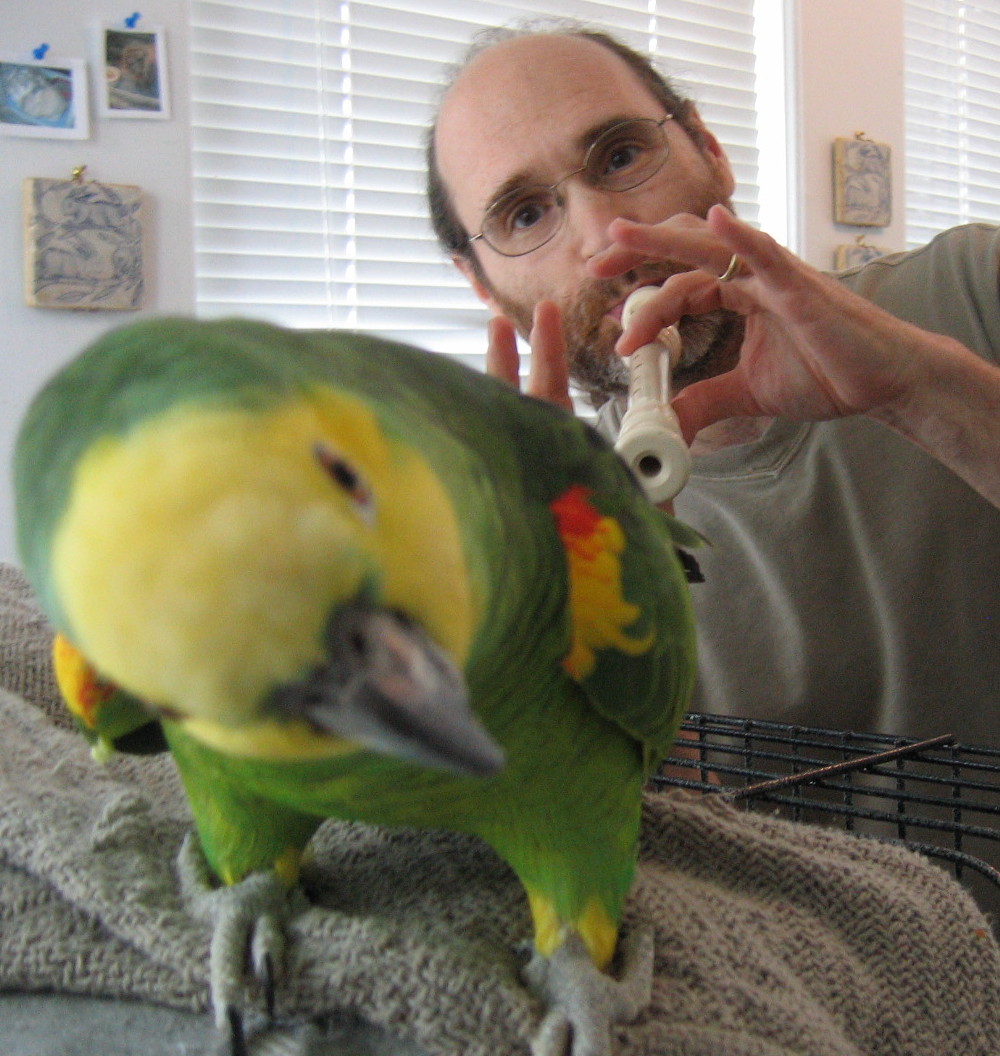
Articulation or Air-ticulation? That is the question.
And that is the DISCOVERY!
From the very beginning, as brass players, we are taught some form of articulation. Whether it is to say "TAH", TOH" or "TUH" and then eventually for trombone players to say "DUH", "DAH" or even "LAH" for legato articulation. All of these suggest the placement of the tongue with a syllable as well.
One famous bass trombonist from 'yesteryear' was a man named John Coffey. He used to say to his students, "Tongue and blow, kid!" In a sense, that can be the very basic mechanics at play without being very specific. When players just think of tongue, oftentimes this can lead to all sorts of tension in the throat and lay the ground for articulation problems such as stutter attacks, where a person has a real difficult time coming in on the first note of anything. So this is where air-ticulation is vital in the three fold mechanism of articulation, air-tongue-embouchure. Remembering to use our air can make things less tense with more fluidity and ease of production.
The serious player will discover eventually what articulation match feels comfortable for them. But one thing I have noticed as a trend is playing really short is out of fashion. Not only short, but having a variety of articulation seems to be 'dated.' Long rounded articulation seems to be what is 'in' now and I see some of the reasons for this. In some of the cases regarding the enlargement of tone size, the longer articulation seemed to match it better or was found easier to produce in conjunction with a larger sound. Plus conductors also seemed to warm to a 'rounder' sound from the brass and naturally this meant not such a pointed front to the articulation.
Let's face it, in terms of having greater accuracy, lots of variation in tone color, dynamics and articulations gets more difficult. It is easier to 'control' just a couple of things rather than a larger number of possibilities. However, I have found that different kinds of articulation build greater control and work on specific areas of the embouchure and air support systems.
Take some of those basic Arban and Kopprasch etudes and use different articulations. Play them really short and dry, soft, short and accented, long with a small little space, accented long with no break and on and on. The various combinations are endless. In the end, I have found each kind of articulation has its merit physically, therapeutically and most importantly musically. Would a great painter only use one kind of brush stroke for everything?
Sunday, July 11, 2010

Friday, July 9, 2010
Supplement for Week 2 of FBSMC 2
What about Loud Playing?
Perhaps in your practicing this week some of you are asking, "Can loud playing build embouchure and air efficiency?" I would have to answer yes to that. Loud playing can build muscle strength and grip in the embouchure. But too much of it can cause the tone to lose certain properties like high overtone ring, sweetness and responsiveness.
If loud playing can be integrated in a balanced way into a person's practice diet, it can be very helpful in building endurance, size and depth of tone and projection to name a few things. Plus we learn something about our lung capacity and the limitations of our range in this louder dynamic. It might stretch us into finding other ways of manipulating our embouchure. This is fine as long as we don't lose the basic overall structural integrity of the embouchure.
Adding more powerful volume levels is good. It can be great to practice them outside if we can. This is where the importance of concept comes in because our bodies, no matter how strong we can get them, have limited fuel and energy levels. But, the power of the mind, once realized, can have unlimited resources and be a very important facilitator in our quest for more power, and more importantly timbre and sonic expansion which is hopefully musically connected at its base.
Certain kinds of practicing are like strong potent vitamins. A little at a time, with care, is the way to go. Listen to what your body is telling you ! When in doubt, STOP. Then start again refreshed !
Perhaps in your practicing this week some of you are asking, "Can loud playing build embouchure and air efficiency?" I would have to answer yes to that. Loud playing can build muscle strength and grip in the embouchure. But too much of it can cause the tone to lose certain properties like high overtone ring, sweetness and responsiveness.
If loud playing can be integrated in a balanced way into a person's practice diet, it can be very helpful in building endurance, size and depth of tone and projection to name a few things. Plus we learn something about our lung capacity and the limitations of our range in this louder dynamic. It might stretch us into finding other ways of manipulating our embouchure. This is fine as long as we don't lose the basic overall structural integrity of the embouchure.
Adding more powerful volume levels is good. It can be great to practice them outside if we can. This is where the importance of concept comes in because our bodies, no matter how strong we can get them, have limited fuel and energy levels. But, the power of the mind, once realized, can have unlimited resources and be a very important facilitator in our quest for more power, and more importantly timbre and sonic expansion which is hopefully musically connected at its base.
Certain kinds of practicing are like strong potent vitamins. A little at a time, with care, is the way to go. Listen to what your body is telling you ! When in doubt, STOP. Then start again refreshed !
Monday, July 5, 2010
Week 2 of the Frequency Bone Summer Music Connection 2
Embouchure and Air, is it a good marriage?
Many times our concepts help shape our playing apparatus. In this case, I of course mean the structure and mechanism of the embouchure and the way we operate our inhales and exhales.
I have seen people who have a concept that does not match their physiology. This creates great conflict and an unnatural feeling in the person.
Some body types and character types do not fully support certain sound concepts. A huge deep wide sound might be what some player wants but it might not be 'them' at the level of their physical framework. Getting bigger equipment might not help either but could actually make it worse! At other times the reason why a player may change equipment could be very useful. In the end, sound production needs to have a natural ease about it and, if it does, that would be a sign of a certain coordination between concept and physiology (and equipment).
If a person has a very tight concentrated mouthpiece sound, that can potentially have the making of a very full resonant quality, if they have a good amount of air to pass through that set up. If not, the quality of the sound might be leaner and not resonate too much of the lower overtone spectrum. As I have said at other times, air speed and temperature come into this. A slower warmer air speed can help the person with a very tight mouthpiece sound to fill out and open up the vibration. The reverse is true of the person with a wide more porous mouthpiece sound where a cooler faster air speed can bring more high overtones into the sound with, of course, a combination of other kinds of exercises. Different syllables also can aid or detract from this process. The syllable OH, is not always useful in making a sound have more size or openness. Depending on the factors of lip vibration quality and air pressure-speed and temperature, OH might be the most inefficient syllable to work with (especially in cases where the sound suffers from lack of center and ring).
I said in the video that efficiency can help broaden one's scope of color, nuance and inflection by the fact a person would have more control to do what they would want. This came up in relation to building more efficiency by practicing softly in a variety of ways. To make this clearer, let's use the example of an oboe player.
An oboe does not have the decibel scope of a brass instrument. So, the oboist needs to make a lot out of a little! Each variation needs to be very vivid. This is done not just by decibel contrast but by nuance and inflections that are hopefully originating from a connected musical intent.
If you have a clear and steady bowl of water, it does not take much movement to cause a ripple does it? If our sound can have that same kind of focus and fluidity, then we have the option of saying a lot without the need of a great wide decibel level. This puts us in a position to create more using less. Sounds very efficient!
Keeping the embouchure intact with good form in the corners and upper and lower lip contact can keep us playing at a good level for many years, for even when we age and find that our air capacity might decrease, we can know that we have an embouchure (in conjunction with musical feelings and nuances) to keep making music full of contrasts and expression.
Many times our concepts help shape our playing apparatus. In this case, I of course mean the structure and mechanism of the embouchure and the way we operate our inhales and exhales.
I have seen people who have a concept that does not match their physiology. This creates great conflict and an unnatural feeling in the person.
Some body types and character types do not fully support certain sound concepts. A huge deep wide sound might be what some player wants but it might not be 'them' at the level of their physical framework. Getting bigger equipment might not help either but could actually make it worse! At other times the reason why a player may change equipment could be very useful. In the end, sound production needs to have a natural ease about it and, if it does, that would be a sign of a certain coordination between concept and physiology (and equipment).
If a person has a very tight concentrated mouthpiece sound, that can potentially have the making of a very full resonant quality, if they have a good amount of air to pass through that set up. If not, the quality of the sound might be leaner and not resonate too much of the lower overtone spectrum. As I have said at other times, air speed and temperature come into this. A slower warmer air speed can help the person with a very tight mouthpiece sound to fill out and open up the vibration. The reverse is true of the person with a wide more porous mouthpiece sound where a cooler faster air speed can bring more high overtones into the sound with, of course, a combination of other kinds of exercises. Different syllables also can aid or detract from this process. The syllable OH, is not always useful in making a sound have more size or openness. Depending on the factors of lip vibration quality and air pressure-speed and temperature, OH might be the most inefficient syllable to work with (especially in cases where the sound suffers from lack of center and ring).
I said in the video that efficiency can help broaden one's scope of color, nuance and inflection by the fact a person would have more control to do what they would want. This came up in relation to building more efficiency by practicing softly in a variety of ways. To make this clearer, let's use the example of an oboe player.
An oboe does not have the decibel scope of a brass instrument. So, the oboist needs to make a lot out of a little! Each variation needs to be very vivid. This is done not just by decibel contrast but by nuance and inflections that are hopefully originating from a connected musical intent.
If you have a clear and steady bowl of water, it does not take much movement to cause a ripple does it? If our sound can have that same kind of focus and fluidity, then we have the option of saying a lot without the need of a great wide decibel level. This puts us in a position to create more using less. Sounds very efficient!
Keeping the embouchure intact with good form in the corners and upper and lower lip contact can keep us playing at a good level for many years, for even when we age and find that our air capacity might decrease, we can know that we have an embouchure (in conjunction with musical feelings and nuances) to keep making music full of contrasts and expression.
Friday, July 2, 2010
Supplement for Week 1 of FBSMC 2
Have a good time but remember....
I hope for those of you who are trying this three-step method that it is showing itself to be useful. If any questions about it come up, or you would like to share your discoveries using this exercise, I encourage you to write it in the comments.
Also, as I'm sure many of you have discovered, you can use anything as a constant plus anything else. So the formula is C (constant) + X (anything else) = R (result). For example, let's say you are working on articulation clarity, you could do articulation plus rhythm or articulation plus tone or articulation plus pitch. In this way, you can use this tool as a diagnostic for your articulation or anything else. It really goes everywhere.
These methods are designed to offer different perspectives and angles on any given facet of playing. Don't be rushed into trying a million combinations. It is just a suggestion. The formula is what it is and there are an infinite number things you can plug into it. Especially useful if you are in a rut with any given aspect.
This coming Monday there will be a new video and a new assignment. Don't feel you have to forget about this one! Have a good weekend but remember to keep up the passion and goal pressure in a constant and cheerful way! Passion-goal-pressure (PGP) + Fourth of July weekend (FJW) = fun and improvement! (FI) :)
I hope for those of you who are trying this three-step method that it is showing itself to be useful. If any questions about it come up, or you would like to share your discoveries using this exercise, I encourage you to write it in the comments.
Also, as I'm sure many of you have discovered, you can use anything as a constant plus anything else. So the formula is C (constant) + X (anything else) = R (result). For example, let's say you are working on articulation clarity, you could do articulation plus rhythm or articulation plus tone or articulation plus pitch. In this way, you can use this tool as a diagnostic for your articulation or anything else. It really goes everywhere.
These methods are designed to offer different perspectives and angles on any given facet of playing. Don't be rushed into trying a million combinations. It is just a suggestion. The formula is what it is and there are an infinite number things you can plug into it. Especially useful if you are in a rut with any given aspect.
This coming Monday there will be a new video and a new assignment. Don't feel you have to forget about this one! Have a good weekend but remember to keep up the passion and goal pressure in a constant and cheerful way! Passion-goal-pressure (PGP) + Fourth of July weekend (FJW) = fun and improvement! (FI) :)
Sunday, June 27, 2010
Welcome to Frequency Bone Summer Music Connection 2
This summer's theme is "Summer, A Great Opportunity for Improvement!!"
Week 1 is focusing on practicing. So the title of our first video is "Your Practice Sessions."
It Takes the Right Attitude To Get the Altitude!
If you think of yourself as the pilot of your improvement, you will quickly see that your attitude plays a key role in your height or altitude of progress. The A.R.T. of someone really serious about growth in any field needs the qualities of Application, Regularity and Targeting. If you want good retention, have immediate application on a regular basis. This will increase your awareness, and your ability to reapproach and fine tune your results.
One obstacle to steady progress is thinking it should happen in a straight line. For actual development to happen it really is necessary for things to go a bit up, down and sideways from time to time so we can get different insights and learn a variety of lessons. Another obstacle is not spending enough time with just a couple of things. Taking on too much can put us on overload making it difficult to process our information clearly and effectively.
Let's say you have forty minutes to practice. You might need five or more minutes to get yourself in a better more clearly focused state of mind and another five or so minutes of horn warm-up time. So now you could have 25 or minutes left for some excellent concentrated time to work on a passage that is giving you a challenge, or play through a couple of excerpts all the way like a mini audition round or work an any area of playing like articulation, slurs, range building, dynamic contrasts. etc.
Remember that you can strain your embouchure in these 25 minutes if you are not thoughtful. Twenty-five minutes of loud high range can really be harmful for some people. You might want to take that twenty-five minutes and play some low range then mid range and then go to some high range playing ending with some low range playing again.
In working on the three step assignment, do some breathing exercises first, followed by some simple mouthpiece glissing in a comfortable range for a minute or two then go to your exercise or piece of your choice. Blowing air on your palm to feel that air pressure is great. I always imagine a micro-cresendo while the air is being blown on my palm as well as thru the trombone. It is so easy to sag which means we are losing our mental focus and intention as well as air support weakening. To become conscious of our mental support, I practice the finger on the palm as shown in the video. Here it is important to practice a micro-increase of pressure for maybe thirty seconds or so to give yourself the discipline of slow but steady pressure and mental focus. Support means not dropping the ball! It can be done in a way that's not full of tension but is held in a stable and balanced way.
In order to get the altitude, we need a supportive and grounded attitude! You can have the greatest methods in the world, but with an unsupportive attitude it will not happen or take you much longer to achieve what you would like. Remember it is the balance between allowance and resistance. Have standards but give yourself the chance to achieve them!
I hope this writing gives some extra clarity to the video. If you have any questions put them on the comment page and I will answer them.
Week 1 is focusing on practicing. So the title of our first video is "Your Practice Sessions."
It Takes the Right Attitude To Get the Altitude!
If you think of yourself as the pilot of your improvement, you will quickly see that your attitude plays a key role in your height or altitude of progress. The A.R.T. of someone really serious about growth in any field needs the qualities of Application, Regularity and Targeting. If you want good retention, have immediate application on a regular basis. This will increase your awareness, and your ability to reapproach and fine tune your results.
One obstacle to steady progress is thinking it should happen in a straight line. For actual development to happen it really is necessary for things to go a bit up, down and sideways from time to time so we can get different insights and learn a variety of lessons. Another obstacle is not spending enough time with just a couple of things. Taking on too much can put us on overload making it difficult to process our information clearly and effectively.
Let's say you have forty minutes to practice. You might need five or more minutes to get yourself in a better more clearly focused state of mind and another five or so minutes of horn warm-up time. So now you could have 25 or minutes left for some excellent concentrated time to work on a passage that is giving you a challenge, or play through a couple of excerpts all the way like a mini audition round or work an any area of playing like articulation, slurs, range building, dynamic contrasts. etc.
Remember that you can strain your embouchure in these 25 minutes if you are not thoughtful. Twenty-five minutes of loud high range can really be harmful for some people. You might want to take that twenty-five minutes and play some low range then mid range and then go to some high range playing ending with some low range playing again.
In working on the three step assignment, do some breathing exercises first, followed by some simple mouthpiece glissing in a comfortable range for a minute or two then go to your exercise or piece of your choice. Blowing air on your palm to feel that air pressure is great. I always imagine a micro-cresendo while the air is being blown on my palm as well as thru the trombone. It is so easy to sag which means we are losing our mental focus and intention as well as air support weakening. To become conscious of our mental support, I practice the finger on the palm as shown in the video. Here it is important to practice a micro-increase of pressure for maybe thirty seconds or so to give yourself the discipline of slow but steady pressure and mental focus. Support means not dropping the ball! It can be done in a way that's not full of tension but is held in a stable and balanced way.
In order to get the altitude, we need a supportive and grounded attitude! You can have the greatest methods in the world, but with an unsupportive attitude it will not happen or take you much longer to achieve what you would like. Remember it is the balance between allowance and resistance. Have standards but give yourself the chance to achieve them!
I hope this writing gives some extra clarity to the video. If you have any questions put them on the comment page and I will answer them.
Friday, June 25, 2010
Frequency Bone Summer Music Connection 2 Starts Next Week!
In the spring, many high school and college students are hoping to get into summer music festivals or music camps. Perhaps a seminar or two. Some even apply to work at these festivals so they can at least be around the excitement that being a part of all the rehearsing, concerts, listening to lots of talented people practicing and new friendships bring.
But what if it is our situation that we did not get into a summer music festival or could not afford to go to one? What can we do to make the most of our time and see tangible progress in our playing during this time? The answer is a ton! So for this year's Frequency Bone Summer Music Connection (FBSMC), we are going to focus on improvement methods and techniques in many areas of playing and music making. Let's face it, with the aid of a computer, there is so much a person can do. In fact without a computer there is an infinite number of things one can do! There is always something that can be done. So with the inspiration of that fact, let's call Frequency Bone Summer Music Connection 2, "Summer, A Great Opportunity For Improvement!"
The FBSMC online music camp will start Monday the 27th of June and go until about July 30th. It might go longer but we'll play it by ear and response. This year the format for the FBSMC will be a bit different. There will be one topic per week which will include a video and a writing or two. So in a way, it will be more like weekly sessions, giving the interested person time to work on, think about, practice and experiment with the material that will be offered. More time to digest and prepare for the next weekly session is the idea behind this format.
Topics to Include:
*There Is Always Another Way or You're Not Bored Are You?
*What Is Tone Color? or How To Avoid 'Color Blindness'
* What is Audition Ready? or Squeezing Through the Mouse Hole
*Embouchure and Air, Is It A Good Marriage?
*Articulation or Air-ticulation? That is the Discovery!
*Is a Good Audition Taker a Good Ensemble Player? (psst! not always!)
*Range Building- Muscle or Technique?
*Chamber of Discovery or Little Room of Torture - Your Practice Sessions
*Process, Product and Result or What is Important and Why
* Your Comments, Questions and My Responses To Them
*Expect the Unexpected But Don't Count On It!
In these sessions there will be many practical exercises for you to practice and work with. There will also be weekly 'assignments' for the interested.
I look forward to working with you all this summer and if you are one of the ones who are at a music festival already, feel free to join in. Some of this material may not be covered in your program! Or at the very least it will offer another approach.
'See' you all next week!!
But what if it is our situation that we did not get into a summer music festival or could not afford to go to one? What can we do to make the most of our time and see tangible progress in our playing during this time? The answer is a ton! So for this year's Frequency Bone Summer Music Connection (FBSMC), we are going to focus on improvement methods and techniques in many areas of playing and music making. Let's face it, with the aid of a computer, there is so much a person can do. In fact without a computer there is an infinite number of things one can do! There is always something that can be done. So with the inspiration of that fact, let's call Frequency Bone Summer Music Connection 2, "Summer, A Great Opportunity For Improvement!"
The FBSMC online music camp will start Monday the 27th of June and go until about July 30th. It might go longer but we'll play it by ear and response. This year the format for the FBSMC will be a bit different. There will be one topic per week which will include a video and a writing or two. So in a way, it will be more like weekly sessions, giving the interested person time to work on, think about, practice and experiment with the material that will be offered. More time to digest and prepare for the next weekly session is the idea behind this format.
Topics to Include:
*There Is Always Another Way or You're Not Bored Are You?
*What Is Tone Color? or How To Avoid 'Color Blindness'
* What is Audition Ready? or Squeezing Through the Mouse Hole
*Embouchure and Air, Is It A Good Marriage?
*Articulation or Air-ticulation? That is the Discovery!
*Is a Good Audition Taker a Good Ensemble Player? (psst! not always!)
*Range Building- Muscle or Technique?
*Chamber of Discovery or Little Room of Torture - Your Practice Sessions
*Process, Product and Result or What is Important and Why
* Your Comments, Questions and My Responses To Them
*Expect the Unexpected But Don't Count On It!
In these sessions there will be many practical exercises for you to practice and work with. There will also be weekly 'assignments' for the interested.
I look forward to working with you all this summer and if you are one of the ones who are at a music festival already, feel free to join in. Some of this material may not be covered in your program! Or at the very least it will offer another approach.
'See' you all next week!!
Friday, June 4, 2010
Not Music Does This Make!
The C.R.A.F.T. of orchestral playing now is:
Consistency Reliability Accuracy Focus Translucent
What about this word translucent? That seems to stick out a bit. How would one go about practicing it? What is meant by translucent here is the ability to blend in with anything so you do not 'disturb' the blend or ensemble. It is the ability of doing what needs to be done and no more than that. No rough edges, no 'risky' chances, and the ability to hide or disguise your weaknesses. It is practical and safe advice if you are a last minute sub for someone on a heavy concert. It might be a somewhat useful strategy for a freelancer as well at times.
Interesting that the uniform of the orchestra is black and white just like a keyboard. And basically a person is auditioning to be a key on the orchestral keyboard.
The orchestral uniform in brass playing right now is getting to be a one size fits all in terms of musical content. To want a uniform sound has its merits but not all music can fit into that confinement. Orchestral players can be so obsessed with evenness of sound they can miss the spirit of the music. Decibel levels are not the only means of color change. The biggest change comes when there is an actual character or frequency change. Then the change is on the level of vibration and sentiment. Finding things on the level of technique only works with a limited part of the human instrument and can never be a replacement for connection to the essence.
Repetition is a very powerful tool. Almost everything has an element of repetition. What is practicing? It is doing things over and over again until it becomes 'second' nature, second nature means it is in our programming and our automatic systems repeat it. BUT, depending on how we practice, we also put our attitudes, emotional states and physical qualities into the programming as well.
Most people have had the experience of reading a book or seeing a movie more than once. Isn't it amazing the things we pick and notice after a second viewing or reading? Same things happen when listening to music over and over again. And with thoughtful practice we can put together and develop other qualities. Even the development of muscular strength happens with repetition. The challenge is to not let the the repeated efforts get so automatic in the practice room that they become unconscious. I know people who are like orchestral excerpt vending machines. Put in a quarter, and out comes a nice prepackaged excerpt. The problem in my view is it can sound stale or out of date meaning past the fresh stage.
Out of date, that is an interesting one. That can get into current fashion, the orchestral uniform of any given era. If a person does want an orchestral job, they need to fit into that uniform. Is it possible to wear the uniform but still put the soul of oneself into it somehow? That would be what I would suggest. Then you don't totally sell your soul.
I can just imagine the great Jedi master Yoda saying, "Good intonation, rhythm and control, not music does this make!" Is the 'Force' with you when you play?
Consistency Reliability Accuracy Focus Translucent
What about this word translucent? That seems to stick out a bit. How would one go about practicing it? What is meant by translucent here is the ability to blend in with anything so you do not 'disturb' the blend or ensemble. It is the ability of doing what needs to be done and no more than that. No rough edges, no 'risky' chances, and the ability to hide or disguise your weaknesses. It is practical and safe advice if you are a last minute sub for someone on a heavy concert. It might be a somewhat useful strategy for a freelancer as well at times.
Interesting that the uniform of the orchestra is black and white just like a keyboard. And basically a person is auditioning to be a key on the orchestral keyboard.
The orchestral uniform in brass playing right now is getting to be a one size fits all in terms of musical content. To want a uniform sound has its merits but not all music can fit into that confinement. Orchestral players can be so obsessed with evenness of sound they can miss the spirit of the music. Decibel levels are not the only means of color change. The biggest change comes when there is an actual character or frequency change. Then the change is on the level of vibration and sentiment. Finding things on the level of technique only works with a limited part of the human instrument and can never be a replacement for connection to the essence.
Repetition is a very powerful tool. Almost everything has an element of repetition. What is practicing? It is doing things over and over again until it becomes 'second' nature, second nature means it is in our programming and our automatic systems repeat it. BUT, depending on how we practice, we also put our attitudes, emotional states and physical qualities into the programming as well.
Most people have had the experience of reading a book or seeing a movie more than once. Isn't it amazing the things we pick and notice after a second viewing or reading? Same things happen when listening to music over and over again. And with thoughtful practice we can put together and develop other qualities. Even the development of muscular strength happens with repetition. The challenge is to not let the the repeated efforts get so automatic in the practice room that they become unconscious. I know people who are like orchestral excerpt vending machines. Put in a quarter, and out comes a nice prepackaged excerpt. The problem in my view is it can sound stale or out of date meaning past the fresh stage.
Out of date, that is an interesting one. That can get into current fashion, the orchestral uniform of any given era. If a person does want an orchestral job, they need to fit into that uniform. Is it possible to wear the uniform but still put the soul of oneself into it somehow? That would be what I would suggest. Then you don't totally sell your soul.
I can just imagine the great Jedi master Yoda saying, "Good intonation, rhythm and control, not music does this make!" Is the 'Force' with you when you play?
Subscribe to:
Comments (Atom)