Friday, October 31, 2008

Repetition-Redundant-Rut...
...New Route!

Practicing is a musician's time to make what they have been taught their own--to build a relationship with a technique, method or piece of music.

One of the essential ingredients in practicing is repetition. Where too much repetition becomes a problem is at the point of repeating something without assessing it, and finding and putting into play the necessary components to improve it. Without this kind of reflective approach, the repetition becomes redundant and soon can turn into a rut, which is not a useful kind of repetition, often referred to as "spinning your wheels."

Contemplation:

To get out of a rut, find a new route.

Tuesday, October 21, 2008

Thought for the Day

Accuracy in certain realms...

... cannot be measured with a ruler.
... cannot be measured by missed notes.
... cannot be measured with a tuner.
... cannot be measured with a metronome.
... cannot be measured in two dimensions.

Monday, October 13, 2008

No Dead Notes!

When you are really involved in the music, of any piece you are playing, there is no room for "dead notes." Dead notes are ones that are not musically connected.

When, for example, a conductor says, "Get out of the way; that part is not important," the player, in my mind, needs to be careful about fostering an attitude that says, "Lay back and just stay out of the way." This is not a musical approach!

A visual example of what I'm saying might be: If you are in a car or on a train trip and there, in the background, are some beautiful mountains. The are not part of the main road or train tracks, or even part of the close up scenery, but the mountains, in all their glory, are still a part of the scene--they are just in the distance. Imagine if someone took a grey blanket and thew it over them, or, someone Photoshopped them "out of the way."

That approach ignores that the mountains are a valid, and living, part of the scene. But they are; they are still mountains, even at a distance! They are still 'ALIVE'!

When there is a part in your music (let's say in an orchestral piece) that, obviously, is not the main theme, it still can be played with significance, because it is part of the living fabric of the sonic texture and musical atmosphere and environment. Can you imagine a fine chamber music group not treating each note with importance and contextual support?

Whatever part you have, make sure you play it with connection to the music and be at full with it, no matter what it is. It does make a difference!

In My Opinion...
Master Class Etiquette, At Home and Abroad

When giving a master class or private lesson to people who are not your regular students, I feel it is very important to not do or say anything that might come across as disrespectful to those students' teachers and/or their work with those students.

Also, I have heard many stories from students going to workshops and seminars in other countries outside their own country. This may seem farther afield, but I think the principle still applies. In this case, I still feel it is important to have a sense of respect for the other various ways and styles of playing other than one's own.

For example, if I am giving a master class in a place where the teaching style and the equipment used are different to my own, I don't suggest that someone should get a new horn or say to them, "Get rid of that instrument because it is junk and the the tone is terrible!" like I have heard some people say in their master classes.

There is not one way to play nor one instrument to play. This, I think, is the kind of attitude that breeds a frozen, one-dimensinal viewpoint that does not breathe or let in new light. Why can we not embrace the differences as all a part of the marvelous spectrum that life and art is? If we were all meant to be exactly the same, then why weren't we all born in the same country, all with exactly the same genetics?

I also do not think it is right, in most cases, to change someone's embouchure at a summer festival if you are not, as a teacher, going to be around to see it through. It is one thing to make suggestions but to insist on a dramatic physical or style change, in a short period of time, actually could be very harmful for some people.

To give some advice and offer some ideas, in the musical or playing realms, that add to the person's musical development is one thing. To degrade and insist that there is only one instrument and one way to play and/or only one interpretation of a piece of music and to attempt to impose significant changes on a student with whom you do not regularly work, is insensitive, arrogant and unrealistic--in my opinion.

Saturday, September 20, 2008

Truth or Agenda?
From "The TAC Legend Writings"

Here is another excerpt from my book, "The TAC Legend Writings,
Book 1: Journey to Freedom."

Master Manlon was giving a masterclass when Tersha raised her hand.

Master Manlon: "Yes Tersha, do you have something to add?"

Tersha: "I wanted to relate a story." 

Master Manlon: "Let's hear it!"

Tersha: "A few weeks ago, I went to Sutherland, where there was a workshop with the famous triuna player Wilkus Tordly.

Different people were playing for him. I was really shocked with how he handled people and the manner in which he addressed their various playing issues. It was the furthest thing from your approach and all the teaching staff in 'The Amazing Club.'

Mr. Tordly was very rough on the people, saying they had terrible sounds and had no idea how to properly play the instrument. He kept asking people who they studied with and told them to change teachers and get instruments that were actually playable.

I was extremely upset and was wondering what was the point of my attending such an affair. Then it hit me how lucky we are to be in the TAC, a place where the teachers realize that, first and foremost, there is a human being with a human instrument, and then there is the musical instrument as an extension of the human instrument with the power of what it is connecting to."

Master Manlon: "Well, I guess you learned a lot from this workshop!

It is important to realize, always, that it is not 'who' is teaching, playing  speaking or acting, but 'WHAT' is doing all those things. We have said many times in the TAC that it is not 'who' wrote the music, but 'what' wrote the music. What is the nature of that life force that would want to treat people that way? Yes, Antil?"

Antil: "The ego?"

Master Manlon: "The ego can be attached to certain things that do not want others to succeed. Lots of times we see that a person who is like that was also treated like that themselves. So that painful 'virus' that they were infected with then needs to infect others so it can have continuance and grow.

Learn to recognize it and and make a pact with yourself that you wish to be different to it. Always remember that when you see some undesirable feature in yourself, try to see that it is not really you but 'what' got into you. Then remember that you have the choice to not have it. That is the profound gift of will. And to activate our will, we need to realize we have choice. But do not expect all the choices you make to be received with a resounding "BRAVO!" from everybody.  So, thinking, deliberately choosing and taking responsibility for your choices isn't always an easy road.

When we treat music as a living thing, and ourselves, other people and other life as living things, truth, even in cases we don't necessary want to hear it either, becomes of greater importance to us than any other personal agenda. It is a beautiful life goal and process to be in the music of being all you can be, regardless of how popular it is or isn't."

Other excerpts from "The TAC Legend Writings" can be found throughout this blog. Here is a sampling:

Trombone Sci-Fi
Excerpt from "The TAC Legend Writings"
Blinded by Sound
Another Excerpt from "The TAC Legend Writings"
More from "The TAC Legend Writings"
More Trombone Sci-Fi
More from Master Manlon and "The TAC Legend Writings"

Saturday, September 13, 2008

Where Did August Go?

I realized there was no blog post in August. Life gets REALLY busy sometimes!!! There actually was a lot going on this summer.

Lots of composing, things with the yard and house, as well as getting settled in a new apartment in Amherst. Amherst is 86 miles from our home in Boston. Why do we have an apartment in Amherst? Because I also will be teaching at the University of Massachusetts in Amherst, on top of everything else! (Here is a photo Carol took of the old chapel by the pond on the UMass campus.)

I (and the rest of the family, rabbits and parrot included) will be there half the week and in Boston the other half of the week to continue teaching at the Boston schools I am affiliated with--New England Conservatory, Boston Conservatory and Longy. That is only part of the schedule!

Carol (who, as you all know, is co-director of the Frequency Band with me) and I are very busy with FB projects. As a matter of fact, we just played at the State House in Boston for the 9-11 Commemoration. All the FB participants involved did a tremendous job in support of this event under very testing conditions. It was a great honor for us to be asked to contribute to such an immensely important event. Seeing and hearing from the family members who lost loved ones on that tragic day in US and world history was something we will never forget.

We are doing other work as well. The FB was asked to play at the Eastern Trombone Workshop. We will be putting on a 90 minute program with the Frequency Band and, also, I will be premiering a new work I am writing for solo trombone and band and look forward to playing this new piece with "Pershing's Own" at this ETW event in March. It will be a very packed week with a masterclass as well! Stay tuned for more details!

So much is on the go and more blog posts will start up again on a regular basis. Some topics will include the "A.R.T. of Teaching" and the "Mystery of the Embouchure-Air Relationship," plus some more of the masterclasses with Master Manlon. Keep in touch, much is on the way.....

Thursday, July 31, 2008

Learn from All

You can learn from anyone and, actually, everything. It does depend on what you are willing and wanting to learn. Some people seem to know a lot about a lot of different things. I am not one of them! But in the areas I am interested in, I learn primarily from experience, observation and continuos effort. And I can see that what I learn in one area applies to many other areas as well.

With musicians, there oftentimes is a closed-mindedness that can come into play around musical development, thinking you can only learn from someone who plays your instrument or who plays in the stlye you want to emulate. Sometimes a person thinks they can only learn from "the great ones." This, in my mind, is biased learning and, therefore, is a huge hinderance to the learning process.

I can truly say I have learned something from all my students. Either mentally, emotionally, musically, ethically, socially, energetically and more. I also have learned a tremendous amount form other instrumentalists, singers, painters, dancers, poets, plumbers and everyone I can think of--including my amazing parrot!

Someone who teaches has an opportunity to really interact and work with another human being and watch all sorts of different ways people develop. How can each person be taught the same way when they don't learn the same way? In my mind, it is my responsibility to try to keep the integrity of the individual intact while trying to help them in their artistic process and growth.

Learn from all and your days will be very full and rich!

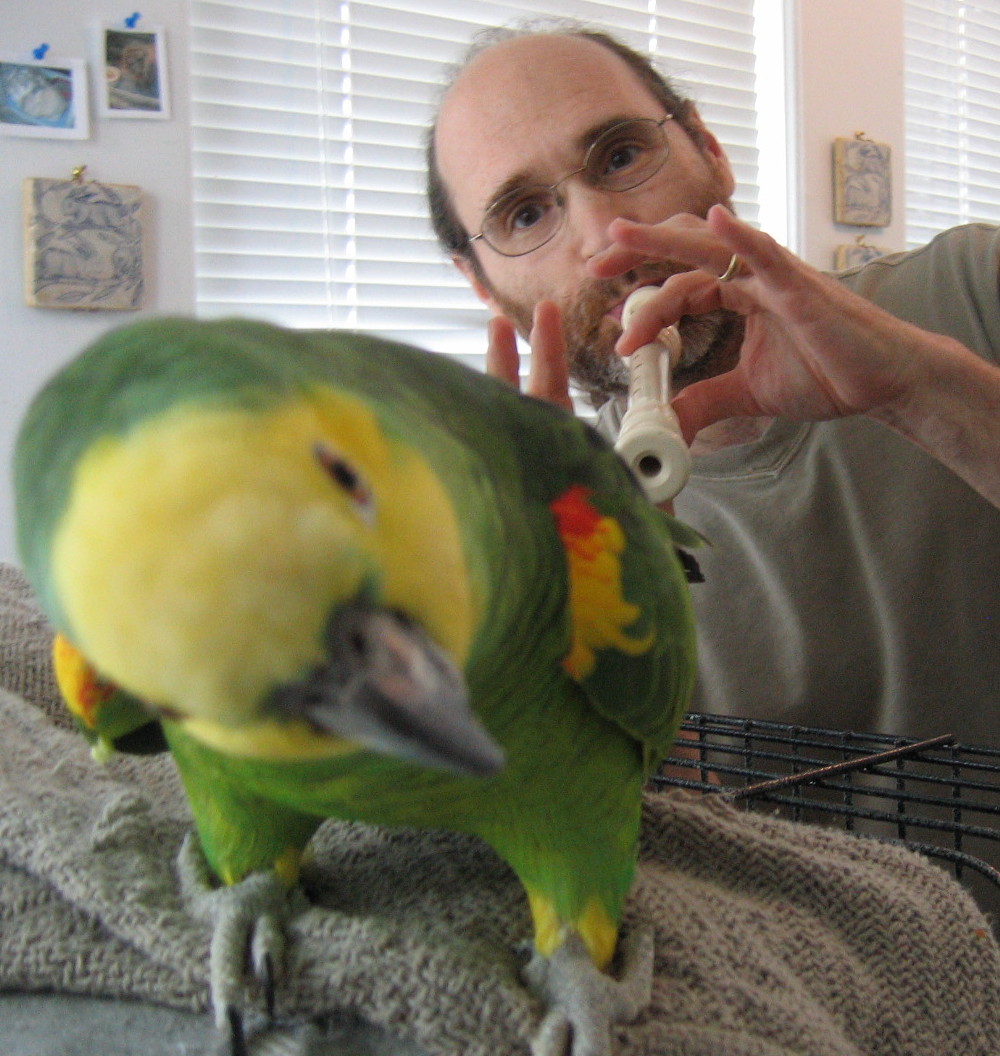
P.S. In the photo, my parrot, Atlantis, is giving me a lesson. I wonder if this is the way I look at my students sometimes? :-)